


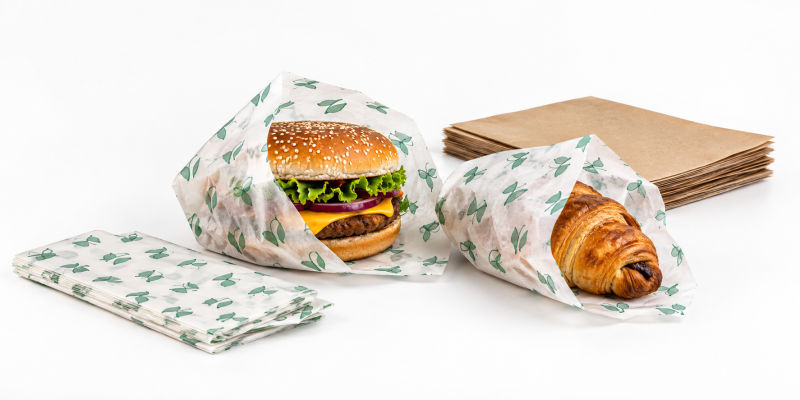
Butter paper is a thin, grease-resistant paper used to wrap and line food. In the UK you will usually see it sold as greaseproof paper, and some suppliers use the name for glassine or waxed sheets as well, so it is not one fixed material.
If you run a bakery, cafe, takeaway or sweet shop, that matters. The paper sits between your food and your customer, and it has to cope with grease, folding and a few minutes in a bag. Get it right and the order looks neat. Get it wrong and you end up with oily patches, torn corners or sweets stuck to the sheet. This guide covers what butter paper is, the types you will come across, how it is used, and what to check before you order a printed version.
What is butter paper?
Butter paper gets its name from one of its oldest jobs, wrapping butter. Today the term covers a wider group of wrapping papers made to hold back oil and fat.
There are two main ways a paper resists grease. Some sheets are made from very finely processed fibres packed tightly together, so oil moves through slowly. Others get a thin coating or are combined with another barrier layer. You cannot tell which one you have just by looking, and two papers that look alike can behave very differently.
Three properties are worth keeping apart. Grease resistance is how well oil is held back. Moisture resistance is how well the sheet copes with wet fillings. Release is whether sticky food comes away cleanly. A paper can do well on the first and badly on the third, which is why a sheet that suits a dry biscuit may not suit a syrupy sweet.
Butter paper or greaseproof paper?
In most UK shops the standard name is greaseproof paper. The term butter paper is more common in South Asian bakeries, sweet shops and wholesale markets, and it is often used for the same kind of sheet. Because suppliers use the words loosely, the label tells you very little. What matters is the material, the treatment and what the paper is rated for.
Baking paper, also called baking parchment, is a different product. It has a silicone surface so food releases easily, and it is made for the oven.
Types of butter paper and similar wraps
These papers can look alike on a shelf, but they do different jobs.
|
Paper |
What it is |
Typical use |
Heat |
|---|---|---|---|
|
Greaseproof paper (butter paper) |
Thin paper that limits oil and fat passing through |
Burgers, sandwiches, pastries, tray and basket liners |
Check the serving temperature with your supplier |
|
Glassine |
Smooth, glossy, slightly see-through sheet |
Confectionery, patisserie and bakery liners |
Not for the oven unless the supplier says so |
|
Wax-coated paper |
Paper with a wax layer |
Cold and chilled food |
Never use in the oven |
|
Kraft greaseproof |
Brown, natural-look paper with grease resistance |
Rustic cafe and takeaway branding |
Check the supplier's specification |
|
Silicone baking paper |
Non-stick sheet made for baking |
Lining tins and trays |
Follow the temperature printed on the pack |
One rule saves a lot of trouble. Wrapping hot food is not the same as baking it. A sheet that is fine around a burger is not automatically safe in an oven.
What butter paper is used for
In a bakery it keeps biscuits, doughnuts and pastries neat and stops grease marking the outer box. A rich, buttery pastry needs more protection than a dry biscuit, so match the paper to the fat content and to how long the item sits packed.
Takeaway wraps take more punishment. A burger, wrap or sandwich gets folded, squeezed and carried, and the paper needs enough strength to survive that. Test it with a real filling rather than judging a clean sheet, because moist ingredients change how paper behaves.
Sweet shops have a different worry, which is sticking. Barfi, glazed pieces and syrupy sweets can pull at a poor sheet. Pack a sample at normal temperature, leave it for the time it would sit in the shop or box, then check for sticking, staining and tearing.
You will also see butter paper used to line trays and baskets, to separate layers in a box, and as an inner wrap in gift hampers.
Why print on butter paper?
A plain sheet does its job and is then forgotten. A printed one carries your brand to the table, the car and the office, and it photographs well when customers share their food.
Think about how the paper will look once it is used. A repeating logo pattern stays visible however the sheet is folded. A single placed logo looks sharper but can end up hidden inside a fold, so test it on a wrapped sample. A few simple rules help:
- Use one or two strong colours. Pale shades can look washed out on a slightly see-through sheet.
- Keep text short, and make sure a web address or QR code is still readable at the finished size.
- Avoid heavy solid colour across the whole sheet, which can look flat on thin paper.
- Approve spelling, direction and placement on the digital proof, and ask for a sample if colour matters.
A proof checks your artwork. It does not tell you how the wrap will cope with food, so keep the sample test separate.
Choosing the right sheet size
Start with the food, not the sheet. Wrap a real burger, pastry or box of sweets with a trial sheet and leave enough overlap for the fold to hold without building a bulky parcel. For a tray or box liner, check how much paper should show above the edge. Once it fits, give your supplier the finished size in millimetres.
If you plan to cut large sheets into smaller portions, say so before the artwork is made. A logo placed for the full sheet can be split or lost after trimming. Most businesses are better off with two or three standard sizes across the menu, which also keeps stock simple for staff.
Food contact, heat and ink
Food wrap has to be suitable for the food and the way you use it. For a printed sheet, that covers the paper, any coating and the ink together. Tell your supplier whether the food is hot, cold, oily or moist, and how long it stays wrapped, then ask for food contact documentation, including a declaration of compliance where it applies.
Be careful with the phrase "rub-resistant ink". It describes how well the print resists scuffing, and it is not the same as being approved for food contact. Keep the printed face away from direct contact with food wherever the supplier advises, and store unused sheets somewhere clean and dry.
Recycling and disposal
A brown or plain look does not make a wrap recyclable. Grease and food residue usually stop paper from being accepted in normal paper recycling, and coatings or laminates can add further limits. The answer depends on the exact product you buy and its condition after use.
Ask your supplier for disposal guidance and check it with your waste collector. If a sheet is described as compostable, ask for the certification and the conditions it needs. Specific information helps your staff sort waste correctly, and it lets you describe your packaging honestly instead of relying on a vague eco-friendly label.
Printed butter paper from GoTo Boxes
We make custom printed butter paper for UK bakeries, cafes, takeaways and sweet shops. You can choose the sheet size, send your logo or artwork and get free design support. There is no minimum order and UK shipping is free. After you approve the final proof, delivery takes 8 to 10 working days.
You can see the options on our printed butter paper page. If you need boxes or containers to go with the wrap, our food packaging range lets you plan both together.
Final thoughts
Butter paper looks simple, but the right sheet depends on your food, your packing method and your brand. Settle the material first, test the fit, then finalise the design on a proof. When you are ready, send us your food type, how you pack it, the sheet size, quantity and your artwork, and request a quote.