





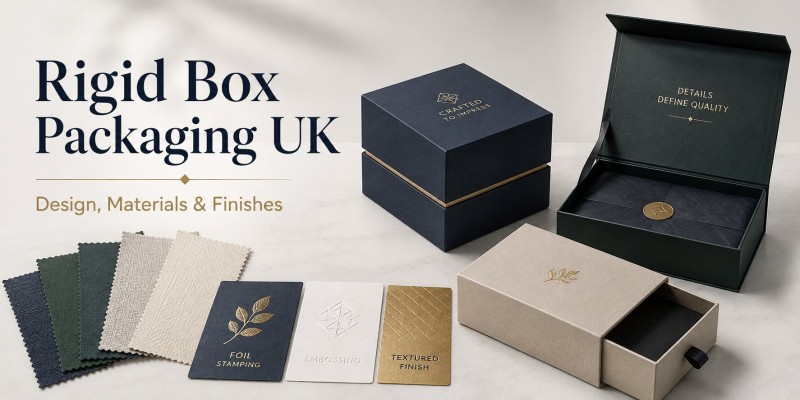
Rigid box packaging gives you a strong, presentation-ready format for products that need more than a standard folding carton. It combines a dense board structure with a printed or textured outer wrap, helping you protect the product while creating a considered opening experience.
For UK brands, rigid boxes are commonly used for cosmetics, jewellery, candles, fragrance, electronics, confectionery, fashion accessories and corporate gifts. They are particularly useful when the packaging must support a premium product price, hold several items in position or arrive ready for gifting.
However, choosing a rigid box is not only a design decision. You also need to consider board thickness, insert construction, storage space, delivery protection, order quantity and material separation.
This guide explains the main rigid box types UK businesses can order, the available rigid packaging materials UK buyers should understand, and the finishes that can improve presentation without adding unnecessary cost or complexity.
What Is Rigid Box Packaging?
Rigid box packaging is made from thick paperboard that is cut and assembled into a permanent structure. The board is then covered with a separate paper wrap, which may be printed, coloured, laminated or textured.
This construction is also known as:
- Set-up box packaging
- Paper-over-board packaging
- Rigid gift packaging
- Chipboard packaging
- Greyboard packaging
In the UK, greyboard is commonly used to describe the dense internal board. The term chipboard packaging UK suppliers use may refer to a similar recycled paperboard material, although specifications can differ between manufacturers.
Unlike thin cartons, traditional rigid boxes normally keep their shape when empty. Most are supplied assembled, but collapsible rigid formats are also available when warehouse space or delivery volume is a concern.
A typical rigid box may include:
- A greyboard or chipboard structure
- Printed or decorative wrap paper
- An internal paper lining
- A paperboard, corrugated or foam insert
- Magnets, ribbons or pull tabs
- Foil, embossing, Spot UV or lamination
Each component should serve a clear purpose. Adding extra materials purely for appearance can increase cost, packing weight and recycling complexity without improving the customer experience.
How Rigid Boxes Differ from Folding Cartons
A folding carton is usually made from a thinner sheet of cartonboard that is printed, cut and creased before being supplied flat. It is folded into shape during packing.
A rigid box uses thicker board and is normally wrapped after the structure has been assembled. This creates a heavier and more substantial format.
The most important differences are practical.
| Feature | Rigid box | Folding carton |
|---|---|---|
| Structure | Thick board with a separate wrap | Thin printed cartonboard |
| Supplied | Usually assembled | Usually flat |
| Storage requirement | Higher | Lower |
| Presentation | Substantial and gift-ready | Lightweight and retail-focused |
| Product support | Strong when combined with an insert | Suitable for lighter products |
| Unit cost | Usually higher | Usually lower |
| Reuse potential | Often retained by customers | Usually disposed of after use |
| Suitable for automation | Limited, depending on style | Often suitable for automated packing |
A folding carton may be the better option when you need low-cost packaging in high volumes. A rigid box becomes more appropriate when presentation, product positioning and structural support justify the additional investment.
The phrase “rigid box vs cardboard” can be misleading because rigid boxes are also made from paperboard. The more useful comparison is between rigid set-up boxes, folding cartons and corrugated shipping boxes.
A rigid box should not automatically be treated as courier-ready packaging. Ecommerce orders will usually need a corrugated outer box or protective mailer to reduce the risk of crushed corners, scuffed wrap paper and water exposure.
Why UK Brands Choose Rigid Boxes in 2026
UK brands choose rigid boxes when the packaging contributes directly to how the product is valued and experienced.
A fitted insert can present each item in a defined position. A hinged lid can control the reveal. Interior printing can display instructions, campaign messaging or product information after the box is opened.
This can support a premium unboxing UK customers are more likely to remember, photograph or retain.
Commercial uses include:
- Gift-ready product collections
- Seasonal and limited-edition ranges
- Product launch and influencer kits
- Corporate onboarding packs
- Jewellery and watch presentation
- Luxury beauty and fragrance sets
- Subscription box upgrades
- High-value electronics and accessories
Rigid box packaging for small business UK orders can work particularly well when it is used selectively.
For example, a candle company may use folding cartons for individual products but introduce a magnetic rigid box for a three-candle gift set. A jewellery business may use simple two-piece boxes for its regular range and reserve shoulder neck boxes for bridal or bespoke collections.
This approach allows you to concentrate your packaging budget on products where the presentation can support a higher selling price.
Types of Rigid Box Packaging
The right structure depends on your product, opening sequence, insert, storage space and budget.
Before choosing a style, consider:
- How the customer should open the box
- Whether the lid must remain attached
- How securely the product must be held
- Whether the box will be reused
- Whether the packaging will be stored assembled
- Whether magnets or ribbons are necessary
- Whether the box will be sent through an ecommerce fulfilment process
Two-Piece Lid and Base Box
A two-piece rigid box has a separate lid and base. It is one of the most recognisable rigid packaging formats and can be made in square, rectangular or custom dimensions.
The lid may cover the full depth of the base or stop part of the way down.
A full-depth lid creates a secure, formal appearance. A shallow lid makes the box quicker to open and allows part of the base colour to remain visible.
A two-piece rigid box is suitable for:
- Jewellery
- Chocolates
- Candles
- Scarves
- Stationery
- Small gift sets
- Corporate gifts
The fit between the lid and base needs careful control. The box should open without excessive force but should not feel loose or unstable.
This style can be combined with paperboard, corrugated, moulded pulp or foam inserts depending on the weight and fragility of your product.
Magnetic Closure Rigid Box
A magnetic closure rigid box normally has a hinged lid with magnets concealed inside the front panel and closing edge.
The magnets create a controlled closing action and keep the box securely shut during handling. The large internal lid area also provides space for printed messaging, product instructions or campaign artwork.
Magnetic rigid boxes are often used for:
- Beauty collections
- Fragrance sets
- Luxury candles
- Corporate gifts
- Electronics
- Product samples
- Press and influencer kits
A book-style magnetic box is normally supplied assembled. Collapsible versions are also available and can reduce storage volume before packing.
Magnets introduce an additional material that may need to be separated before recycling. Where simpler material separation is a priority, consider whether a friction-fit lid, ribbon tie or paper closure could provide the required function.
Drawer Slide Box
A drawer slide box contains an inner tray that moves in and out of an outer sleeve. It may include a ribbon, paper tab or thumb cut-out to help the customer open it.
This structure creates a gradual reveal and works well when several small products need to be displayed in a neat sequence.
Drawer boxes are suitable for:
- Jewellery
- Confectionery
- Wax melts
- Fragrance samples
- Stationery
- Technology accessories
- Small skincare products
The relationship between the tray and sleeve must be tested carefully. If the fit is too tight, the customer may struggle to open the box. If it is too loose, the drawer may slide out unexpectedly.
Wrap-paper thickness, lamination and production tolerances can all affect the final movement.
Shoulder Neck Box
A shoulder neck box includes a raised internal section that extends above the base. The lid fits over this section, leaving a visible band between the lid and base when the box is closed.
The raised shoulder can match the outer box or use a contrasting colour, metallic paper or textured wrap.
Shoulder neck boxes are often selected for:
- Perfume
- Watches
- Jewellery
- Premium skincare
- Collectable products
- Special-edition gifts
This style provides a precise, architectural appearance. It also uses more components than a straightforward two-piece box, so it can involve additional material, assembly and cost.
A shoulder neck construction is most effective when the visible central band is treated as part of the design rather than as an unnecessary extra layer.
Clamshell Rigid Box
A clamshell rigid box has a lid and base connected by a hinge. Both sections remain attached when the box is opened.
The closure may use:
- Concealed magnets
- Ribbon ties
- A fitted closing edge
- A tab or paper mechanism
Clamshell boxes are useful for:
- Books and portfolios
- Product collections
- Presentation documents
- Premium apparel
- Gift cards with products
- Sample and demonstration kits
Because the lid and base are connected, the hinge area must be engineered to withstand repeated opening. The wrap paper should fold cleanly without splitting, lifting or creating visible stress marks.
A physical sample is advisable when the box has a large lid, heavy insert or textured wrap material.
Custom Shape Rigid Box
A custom shape rigid box is developed around a particular product, campaign or visual concept.
Possible formats include:
- Hexagonal boxes
- Circular boxes
- Multi-level presentations
- Compartment boxes
- Angled structures
- Custom sleeves
- Product-shaped constructions
Custom shapes can create a distinctive presentation, but they also require more structural development, tooling, prototyping and hand assembly.
Use a custom structure when it improves product fit, supports a campaign idea or solves a genuine presentation problem. A complex shape is unlikely to provide good value when a standard rectangular structure would protect and display the product equally well.
Rigid Box Materials Explained
Rigid boxes are built from several components. The visible surface may look simple, but the final performance depends on the relationship between the structural board, wrap paper, adhesive, insert and finish.
Understanding the materials helps you avoid two common problems:
- Paying for excessive thickness or decoration that the product does not need
- Selecting a visually attractive material that performs poorly during packing or delivery
Greyboard and Chipboard Thickness Guide
Greyboard forms the structural walls of most rigid boxes. It is usually manufactured from compressed recycled paper fibres and covered by a separate wrap.
Board thickness is often specified in millimetres. Many rigid packaging projects use board between approximately 1.5 mm and 3 mm, although the correct thickness depends on the application.
| Indicative thickness | Possible use |
| 1.0 to 1.5 mm | Small, lightweight products and compact jewellery boxes |
| 1.5 to 2.0 mm | Cosmetics, candles, accessories and medium gift sets |
| 2.0 to 3.0 mm | Larger boxes, heavier products and wide lids |
| Above 3.0 mm | Oversized, specialist or particularly demanding structures |
These figures should be treated as a starting point rather than a final specification.
Your supplier should consider:
- Product weight
- Box length, width and depth
- Lid size
- Unsupported panel area
- Insert design
- Stacking requirements
- Delivery conditions
- Expected reuse
- Desired edge appearance
Thicker board is not always better.
On a small box, excessive thickness can make the structure look bulky. It can also reduce the internal capacity and increase shipping weight. On a large box, a thinner board may flex even when the product itself is relatively light.
The insert also affects the required board thickness. A well-designed internal fitment can help distribute weight and reduce movement.
Wrap Paper Options: Gloss, Kraft and Textured
The wrap paper controls the visible colour, print and feel of the box.
Printed coated paper
A smooth white coated paper gives you the greatest control over full-colour artwork, photography, gradients and detailed illustrations.
It can be combined with matte or gloss lamination for additional surface protection.
Gloss wrap and coating
Gloss surfaces reflect more light and can make strong colours appear brighter.
They are often used for:
- Confectionery
- Colourful gift products
- Children’s products
- Photographic packaging
- Bold retail collections
A gloss surface can show scratches and handling marks, particularly on large uninterrupted panels, so transit protection should be considered.
Kraft-style paper
Brown or white kraft-style wraps provide a more natural and material-led appearance.
Printing on brown kraft will look different from printing on white coated paper. Colours may appear more muted, and lighter inks may need additional production consideration.
Kraft-style paper works well for:
- Natural cosmetics
- Handmade products
- Artisan food gifts
- Sustainable product ranges
- Minimal branding
The visual appearance of kraft does not automatically confirm recycled content or recyclability. Ask for the actual paper specification.
Textured paper
Textured papers can include:
- Linen effects
- Felt-marked surfaces
- Embossed patterns
- Pearlescent finishes
- Metallic papers
- Soft uncoated stocks
These materials can create visual interest without extensive print coverage.
Texture can affect foil application, fine typography, adhesive performance and print clarity. Always test small lettering, thin lines and large foil areas on the selected paper.
Eco-Friendly and EPR-Compliant Materials
A box should not be described as EPR compliant simply because it is made mainly from paper.
Extended Producer Responsibility relates to the business placing packaging on the UK market and the duties that apply to that business. These duties may include collecting packaging data, reporting material weights and assessing recyclability.
Your packaging specification can support this process by making material information easier to record and by reducing unnecessary mixed components.
When planning EPR compliant packaging UK projects, consider:
- The weight of each packaging component
- Recycled content in the board and paper
- Responsible paper sourcing
- The number of different materials used
- Whether magnets, foam or plastic films are essential
- Whether components can be separated easily
- Whether the insert can be made from paperboard
- Whether the box is larger than the product requires
- Whether supplier material data can be retained for reporting
A rigid box may look paper-based while still containing:
- Magnets
- Plastic foam
- Polyester ribbon
- Fabric
- Metallic film
- Lamination
- Plastic windows
These materials can affect how the packaging should be classified or disposed of.
GoTo Boxes can help you compare available materials and constructions, but you should confirm your organisation’s legal responsibilities through current government guidance or an appropriate packaging compliance adviser.
Rigid Box Finishes and Design Options
Luxury rigid box finishes can improve the appearance and tactile quality of your packaging. However, the strongest design is not necessarily the one with the greatest number of finishes.
A restrained combination often looks more considered.
For example:
- Textured black paper with one silver foil logo
- Uncoated white paper with a blind deboss
- Matte printed wrap with selective Spot UV
- Kraft-style wrap with a single-colour print
- Soft-touch navy wrap with restrained gold foil
Choose finishes that support your product and customer rather than applying every available effect to the same surface.
Matte and Gloss Lamination
Lamination applies a thin protective film over the printed wrap.
Matte lamination
Matte lamination reduces reflection and creates a smooth, understated appearance.
It works well with:
- Dark colours
- Minimal layouts
- Metallic foil
- Spot UV
- Premium cosmetics
- Technology products
Dark matte surfaces can show fingerprints or rubbing, so a handled sample should be reviewed before production.
Gloss lamination
Gloss lamination creates a brighter and more reflective finish.
It is useful when you want to emphasise:
- Strong colour
- Photography
- Illustration
- Confectionery designs
- High-impact retail presentation
Lamination changes the material composition of the wrap. Where simpler recycling is important, ask whether an unlaminated paper, aqueous coating or alternative surface treatment could provide acceptable performance.
Spot UV
Spot UV applies a clear gloss coating to selected parts of the design.
It can highlight:
- Logos
- Patterns
- Product names
- Illustrations
- Borders
- Tone-on-tone graphics
The strongest contrast is often achieved by applying Spot UV over a matte background.
Avoid placing very fine Spot UV details close to corners, wrapped edges, hinges or board joints. Small movements during production can make fine registration differences more noticeable.
Foil Stamping: Gold, Silver and Rose Gold
Foil stamping uses heat and pressure to transfer foil onto the surface of the wrap.
Popular options include:
- Gold
- Silver
- Rose gold
- Copper
- Holographic foil
- Coloured pigment foil
- Matte metallic foil
Foil stamping packaging UK projects often use the process for logos, short product names, borders and small design details.
Foil can be particularly effective when the rest of the packaging is simple. A single metallic mark on a textured or matte background can look more premium than a large area of reflective foil.
Your artwork may need adjustment when it contains:
- Very small text
- Thin lines
- Fine details
- Large solid foil areas
- Designs crossing a fold or corner
The appearance of the foil also depends on the wrap underneath it. The same gold foil may look brighter on white paper and more restrained on a dark textured stock.
Embossing and Debossing
Embossing raises an area of the paper. Debossing presses the design into the surface.
These techniques can create depth without adding another printed colour.
They are well suited to:
- Logos
- Monograms
- Simple patterns
- Initials
- Crests
- Short product names
The quality of the result depends on the paper, artwork, tooling depth and position.
Detailed embossing should not be placed across a corner, hinge or board joint. Textured papers may also reduce the visibility of very fine embossed details.
Foil and embossing can be combined, although this requires more accurate registration and may increase tooling and production costs.
Velvet Touch Lamination
Velvet touch lamination is also known as soft-touch or soft-feel lamination. It creates a smooth, suede-like surface.
A velvet touch rigid box can work well for:
- Cosmetics
- Fragrance
- Jewellery
- Technology
- Premium stationery
- Luxury gifts
The tactile finish can make the box feel more substantial, particularly when paired with foil or a restrained deboss.
Dark velvet-touch surfaces should be checked for:
- Fingerprints
- Scuffing
- Transit rubbing
- Dust marks
- Changes in colour under different lighting
A physical sample is more reliable than a digital image when comparing soft-touch surfaces.
Interior Design Options
The interior is responsible for holding the product, controlling movement and creating the reveal.
Common interior options include:
- Printed inside lids
- Coloured internal wraps
- Paperboard fitments
- Corrugated inserts
- Moulded pulp
- Foam inserts
- Fabric-covered trays
- Velvet-covered inserts
- Ribbon lifting tabs
- Product compartments
- Instruction cards
- Printed sleeves
The insert should hold the product securely without making it difficult to remove.
Useful design features include:
- Finger notches
- Ribbon pulls
- Clearance around the product
- Separate compartments
- Raised product platforms
- Protective layers between products
Paperboard inserts can provide a clean appearance and may simplify material separation. Corrugated inserts can be useful for heavier products or ecommerce applications.
Foam offers precise cushioning for some fragile items, but it introduces another material and may make end-of-life separation more difficult.
For candles, glass bottles, ceramics and electronics, test the complete pack inside its intended shipping box. A presentation box that performs well on a desk may not provide enough protection inside a courier network.
Which Industries Use Rigid Box Packaging in the UK?
Rigid boxes are most suitable where presentation, organisation or product support justifies the additional cost.
| Industry | Typical application |
| Beauty and skincare | Gift sets, routines, PR launches and limited editions |
| Jewellery and watches | Two-piece boxes, shoulder boxes and fitted display trays |
| Candles and fragrance | Candle sets, diffusers, perfume and home-fragrance collections |
| Electronics | Devices, accessories, samples and demonstration kits |
| Fashion | Scarves, belts, wallets, ties and premium accessories |
| Confectionery | Chocolates and gift assortments with suitable primary packaging |
| Corporate gifting | Client gifts, employee welcome packs and event presentations |
| Stationery | Notebooks, pens, art materials and presentation sets |
| Wellness | Aromatherapy, self-care and subscription collections |
The rigid outer box does not replace any primary packaging, product labelling or safety requirements that apply to food, cosmetics, electrical goods or other regulated products.
Rigid Box Packaging vs Cardboard Boxes: A Quick Comparison
The best box depends on whether your priority is presentation, retail efficiency or courier protection.
| Feature | Rigid box | Folding carton | Corrugated box |
| Main material | Thick wrapped greyboard | Thin cartonboard | Fluted corrugated board |
| Delivery format | Usually assembled | Usually flat | Flat or pre-glued |
| Presentation level | High | Medium to high | Functional to branded |
| Storage efficiency | Lower | High | Medium |
| Courier protection | Usually needs an outer box | Usually needs an outer box | Designed for shipping |
| Insert options | Extensive | Moderate | Extensive |
| Relative cost | Higher | Lower | Depends on grade and print |
| Best use | Premium and gift products | Everyday retail products | Ecommerce and transport |
In many ecommerce projects, the correct solution is not rigid box or corrugated box. It is a combination of both.
The rigid box handles presentation. The corrugated outer box protects the rigid packaging during storage, fulfilment and delivery.
How to Order Custom Rigid Box Packaging from GoTo Boxes
The most accurate quotation starts with clear product and project information.
Providing only a logo and asking for “a luxury box” leaves too many structural decisions unresolved. Instead, prepare the following details before requesting custom rigid boxes UK pricing.
1. Measure Your Product
Provide the exact product dimensions:
- Length
- Width
- Height
- Weight
Measurements should include any caps, handles, cables, protective bags or accessories that will be packed with the product.
For a gift set, confirm:
- The dimensions of every item
- The preferred arrangement
- Which product should be seen first
- Whether items must be removable separately
- Whether printed literature is included
Do not estimate measurements from a product photograph. Even a small dimensional error can affect the fit of the insert and lid.
2. Explain How the Box Will Be Used
Tell GoTo Boxes whether the packaging is intended for:
- Retail shelves
- Ecommerce delivery
- Corporate gifting
- Subscription orders
- Influencer campaigns
- Product launches
- Trade shows
- Seasonal collections
- Long-term product storage
A box intended for hand-delivered corporate gifts may need a different specification from one being shipped through a courier network.
3. Provide Realistic Quantities
Ask for quotation options at several realistic quantities.
For example:
- 250 units
- 500 units
- 1,000 units
This helps you compare the saving per unit against the total amount of stock you will need to store and pay for.
A lower unit price is not automatically better if the order quantity ties up too much cash or leaves you with packaging that becomes outdated after a product change.
4. Choose a Box Structure
Select the structure that best suits the product and customer experience:
- Two-piece lid and base
- Magnetic closure
- Drawer box
- Shoulder neck box
- Clamshell box
- Custom shape
Remain open to structural recommendations. A simpler construction may reduce cost, improve packing speed or use fewer mixed materials while still delivering the required presentation.
5. Select the Board, Wrap and Insert
Your specification should consider:
- Board thickness
- Printed or coloured wrap
- Matte, gloss or uncoated surface
- Paper texture
- Internal wrap colour
- Insert material
- Product clearance
- Closure type
- Recycling and separation requirements
The insert should be designed alongside the outer box rather than treated as an afterthought.
6. Prepare Your Artwork
Provide artwork in the requested production format.
Useful files and information include:
- Vector logo files
- Brand colour references
- Fonts or outlined text
- Barcode placement
- QR code placement
- Product information
- Interior messages
- Foil artwork layers
- Spot UV artwork layers
- Embossing or debossing layers
- Reference images
Screen colours are not always an accurate representation of printed colour. Where colour consistency is important, provide Pantone references and review a physical sample.
7. Review the Proof and Sample
A digital proof allows you to check:
- Artwork position
- Text
- Dimensions
- Orientation
- Print areas
- Finish placement
A physical sample allows you to assess:
- Board strength
- Lid fit
- Opening resistance
- Colour
- Surface texture
- Foil appearance
- Insert fit
- Product removal
- Corner quality
- Box weight
- Overall presentation
Sampling is especially valuable for magnetic boxes, unusual structures, heavy products and specialist papers.
8. Confirm Production and Delivery Details
Before placing the order, confirm:
- Final dimensions
- Quantity
- Materials
- Printing method
- Finishes
- Insert specification
- Packing format
- Delivery address
- Target delivery date
- Production schedule
- Whether the boxes arrive assembled or flat
- Quality tolerances
Minimum order quantities and production times depend on the box structure, dimensions, materials, finishes and order volume. Confirm your required quantity and delivery date when requesting a quotation from GoTo Boxes.
Conclusion
Rigid packaging works best when the structure, materials and finishes are chosen around the product rather than around a generic idea of luxury.
Your box should:
- Hold the product securely
- Open without frustration
- Support your selling price
- Survive storage and handling
- Use finishes with a clear purpose
- Avoid unnecessary materials
- Fit within your available budget and storage space
A two-piece box may provide everything you need for a jewellery or candle range. A magnetic closure may be more appropriate for a launch kit or premium gift set. A drawer box may improve the reveal for smaller products, while a shoulder neck box can create a more architectural presentation.
For small businesses, the most commercially sensible approach is often to use rigid packaging for flagship products, gift sets and limited editions rather than applying it to every item.
To request a quotation from GoTo Boxes, provide your product dimensions, weight, quantity, preferred box style, finish requirements, delivery postcode and target date. This gives the packaging team enough information to recommend a practical structure, suitable materials and a realistic production specification.