










| Box Style | As Mention Above |
|---|---|
| Dimension (L + W + H) | All Custom Sizes & Shapes |
| MOQ | NO Minimum |
| Paper Stock | 10pt to 28pt (60lb to 400lb) Eco-Friendly Kraft, E-flute Corrugated, Bux Board, Cardstock |
| Printing | No Printing, CMYK, CMYK + 1 PMS color, CMYK + 2 PMS colors |
| Finishing | Gloss Lamination, Matte Lamination, Gloss AQ, Gloss UV, Matte UV, Spot UV, Embossing, Foiling |
| Included Options | Die Cutting, Gluing, Scored,Perforation |
| Additional Options | Eco-Friendly, Recycled Boxes, Biodegradable |
| Proof | Flat View, 3D Mock-up, Physical Sampling (On request) |
| Turnaround | 8 - 10 Business Days |
| Shipping | FLAT Position |
Custom Bliss Boxes Designed Around the Distribution Journey
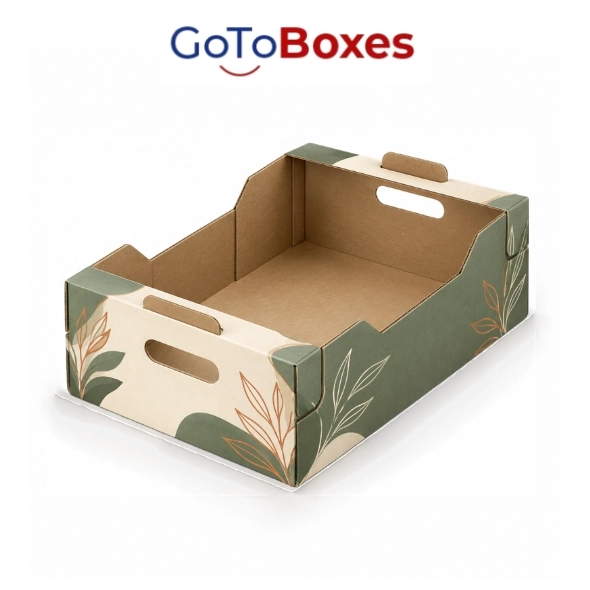
A Bliss box is a three-piece corrugated container made from one wraparound body and two separate end panels. Once the panels are bonded to the body, the finished pack gains firm corners, strong vertical support and reliable stacking performance.
This construction is particularly useful when an ordinary folding carton lacks the required strength. Custom Bliss boxes can be designed around the product’s weight, packing method, pallet arrangement, storage conditions and final presentation. The result is a container that protects its contents without relying on unnecessary board thickness.
GoTo Boxes supplies custom Bliss boxes UK businesses can specify for fresh produce, jars, bottles, canned goods, components, household products and other demanding applications. Designs can be produced for transport, retail display or a combination of both.
What Makes a Bliss Box Different?
A traditional slotted carton is normally cut from one piece of corrugated board. A Bliss box uses three pieces. Its two end panels are attached to a scored body section that forms the base, sides and closure.
This distinction matters because the end panels can be made from a different board grade from the body. A heavier end panel may be used where extra compression resistance is needed, while a lighter wraparound body helps control material use and cost.
Bliss packaging is sometimes described as rigid packaging because it holds its formed shape and cannot usually be collapsed like a standard shipping carton. It should not be confused with a luxury greyboard gift box. The strength comes from corrugated construction, reinforced ends and bonded joints rather than decorative rigid-board wrapping.
Specify the Box from the Product Outwards
A dependable box starts with the contents, not a standard size list. Product weight, dimensions and movement inside the pack all affect the final specification.
Internal Dimensions and Packing Clearance
Dimensions should normally be supplied as internal length, width and height. Measure the complete packed arrangement, including caps, handles, protective bags, dividers, trays and cushioning.
Allow enough clearance for efficient packing without leaving excessive empty space. A box that is too tight can place pressure on the product or make a packing line slower. An oversized box permits movement, increases board consumption and may reduce pallet efficiency.
For products packed by machine, the design must also allow for equipment tolerances and the direction in which the items enter the container. Hand-packed products may need finger clearance or removable dividers.
Weight, Pallet Pattern and Stack Height
The gross packed weight is more useful than the weight of one item. The packaging specification should also consider how many boxes will sit on each pallet layer, how many layers will be stacked and how long the load will remain in storage.
A box that performs well as a single parcel may behave differently at the bottom of a full pallet. Compression requirements should therefore be considered alongside board grade, flute direction, corner alignment and humidity.
Choosing the Right Corrugated Material
Corrugated board is generally the most suitable material for a true Bliss box. Its fluted centre provides cushioning and vertical support, while the inner and outer liners create printable surfaces and help resist punctures.
The best material is not automatically the thickest option. For most customers, the better choice is the lowest practical board grade that passes realistic packing, handling and stacking trials. This avoids paying for excess fibre while maintaining the protection the product requires.
E, B and C Flute Applications
E flute is a thin corrugated profile, commonly around 1.5 mm depending on the board specification. It provides a relatively smooth printing surface and may suit lightweight retail packs or smaller display trays. It is not normally the first choice for a heavy, high-stacked load.
B flute is commonly around 3 mm thick. It offers a useful balance between puncture resistance, stacking performance and print quality. It can suit jars, bottles, canned products and general retail distribution when the board grade is correctly matched to the load.
C flute is commonly around 4 mm thick. Its deeper profile provides more cushioning and can be suitable for fresh produce, larger containers and products that experience frequent handling.
Double-wall combinations such as EB or BC flute may be considered for heavy goods, demanding pallet loads, longer distribution routes or products requiring greater impact protection. Double-wall board increases strength but also uses more material and storage space, so it should be selected from test results rather than appearance alone.
Kraft and White-Top Liners
Natural Kraft liners suit transport-led packaging, agricultural products and brands that want a straightforward paper-based appearance. Kraft surfaces also tend to make minor handling marks less obvious.
A white-top liner provides a cleaner base for detailed graphics, product identification and stronger colour contrast. It can be helpful when the same box must move through distribution and then appear in a customer-facing display.
For chilled or moisture-prone environments, board performance must be assessed under the actual conditions of use. Moisture-resistant papers or suitable coatings may be needed, but any coating should be considered alongside recyclability and food-contact requirements.
Shapes and Structural Features That Solve Packing Problems
The standard Bliss format is rectangular, although the proportions can be adapted for shallow, square, wide or tall products. It may be developed as a closed container, open-top produce tray, shelf-ready pack or lidded format.
Ventilation slots can support airflow around fresh produce. Hand holes can make manual handling easier, while stacking tabs and matching recesses may improve pallet alignment. Display cut-outs can expose the product after part of the outer panel is removed.
Internal dividers help separate glass bottles, jars and canned products. Base pads, corner supports or fitted inserts can be added where concentrated loads might otherwise distort the bottom panel.
Each feature changes the board’s strength. Large hand holes, display openings and ventilation slots remove material from load-bearing areas, so their position should be checked during structural development.
Structural Quality Should Be Tested, Not Assumed
Box strength cannot be confirmed from flute name alone. Paper grade, recycled fibre content, board construction, joint quality, moisture and box dimensions all affect performance.
A representative sample should be packed with the real product wherever possible. The trial should check product fit, base deflection, closure security, lifting points and movement inside the pack. For palletised goods, testing should also reflect the intended stack height and storage period.
Products travelling through chilled storage need testing after the board has been exposed to realistic humidity. For parcel delivery, consider drops, vibration, corner impacts and repeated handling. A visually attractive sample is not enough if it has only been tested empty.
This practical approach adds trust to the buying process. It also reduces the risk of approving packaging based on unsupported load claims or a material description that does not reflect the final packed conditions.
Printing Bliss Boxes for Identification and Brand Recognition
Printed Bliss boxes can carry more than a logo. Handling instructions, product varieties, batch references, recycling information, barcodes and destination details can all be incorporated into the artwork.
Flexographic printing is often suitable for corrugated transport packaging and larger production quantities. It works well for logos, handling marks, solid colours and clear product identification.
Digital printing can be useful for prototypes, shorter quantities or designs that change regularly. Lithographic print laminated to corrugated board may be considered where detailed photography and a smoother retail finish are required.
For custom Bliss boxes with logo printing, artwork should be planned around folds, glue areas, ventilation holes and hand openings. Important text should not cross structural scores. Barcodes require sufficient contrast and a clear quiet zone so they remain readable after packing and transit.
CMYK printing suits photographic or multi-colour designs. Specified spot colours may provide closer control over important brand colours. The chosen printing method, board surface and finish can all affect the final colour, so approving a production proof is safer than judging colour from a screen alone.
Decorative finishes should have a business purpose. A coating that improves rub resistance may be useful for customer-facing packs, while heavy lamination or unnecessary embellishment can increase cost and complicate recycling.
Matching Bliss Packaging to Different Industries
Fresh produce businesses often need ventilation, strong corners and board that retains useful strength in cooler, humid conditions. Open-top or display-ready formats can reduce the need to repack goods before shelf presentation.
Bottle, jar and canned-goods suppliers may prioritise puncture resistance, dividers and a strong base. The internal layout should stop containers from striking one another while keeping the load evenly distributed.
Manufacturers of components or household products may need heavier end panels, double-wall board or reinforced lifting points. The correct specification depends on the concentrated weight of the contents and the way the box is moved.
Retail and promotional packs place greater emphasis on surface appearance. White-top board, controlled colour reproduction and carefully positioned display openings can turn a transport container into part of the shelf presentation.
If food will touch the packaging directly, the material, ink, adhesive and coating must be suitable for the intended contact conditions. Request the relevant food-contact information instead of assuming that every paper-based board is approved for direct contact.
A Practical UK Produce Example
Riverford Organic Farmers sells weekly boxes of fresh fruit and vegetables to UK households. This illustrates the type of packing challenge a produce business must solve: mixed items have different weights, shapes, ventilation needs and sensitivity to pressure.
A suitable Bliss design for this type of application would require airflow without weakening the corners, enough base support for heavier vegetables and sensible internal dimensions that reduce movement. This is an application example only and does not imply that Riverford uses this exact packaging or has a supplier relationship with GoTo Boxes.
Planning Bliss Boxes Wholesale Orders
When comparing Bliss boxes wholesale quotations, look beyond the lowest unit price. Board grade, print coverage, joints, forming requirements, delivery format, storage space and expected waste can change the true cost of using the packaging.
Higher quantities may reduce the unit price, but ordering more than the business can store or use creates another cost. Corrugated packaging should be kept in a clean, dry location and protected from crushing before it reaches the packing area.
Ask for price breaks at realistic quantities and compare the total order value. Repeat buyers should record the approved dimensions, material code, print version and structural drawing so later orders can be checked against the same specification.
Information Needed for an Accurate Quotation
Providing complete information reduces revisions and helps the packaging team recommend a suitable starting specification. Send:
- Internal length, width and height, with the measurement unit
- Gross packed weight and number of products per box
- Product type and any fragile, sharp or moisture-sensitive areas
- Required quantity and expected repeat-order frequency
- Packing method, pallet arrangement and intended stack height
- Delivery, storage and temperature conditions
- Printing colours, logo files, barcodes and required finishes
- Ventilation, hand holes, dividers, inserts or display openings
If some details are not yet available, a physical product sample or a clear packing diagram can help establish the initial layout.
Proofing and Approval Before Production
The structural drawing should be checked before artwork is finalised. Confirm that the internal dimensions, panel arrangement, openings and closure method match the intended product.
Review every proof for spelling, legal information, product codes, colours and barcode placement. A three-dimensional visual can help show panel relationships, but it does not replace a physical fit test.
For a new product, heavy load or unusual packing environment, request a representative sample. Approve bulk production only after the product has been packed, handled and reviewed under conditions close to actual use.
Keep the approved proof and specification reference for future orders. This creates a clear record and helps prevent unplanned changes to board, dimensions or artwork.
Why Choose Bliss Boxes for Demanding Products?
Bliss boxes are worth choosing when stacking strength, reinforced corners and efficient use of corrugated material matter more than the simplicity of an ordinary carton. The three-piece structure allows the body and end panels to be specified around different performance needs.
A well-designed Bliss box can support packing, palletisation, transport and retail display in one format. GoTo Boxes can help translate the product dimensions, gross weight, handling route and artwork into a practical specification, giving buyers a clearer basis for sampling, approval and repeat production.